Author: Resolute Wealth Advisor Team

When Strong Markets Change More Than Your Returns

Strong markets have a way of changing financial plans — often without much notice.

The past few years have helped many portfolios grow, in some cases faster than expected. What’s less obvious is how that growth can quietly shift risk, even when no decisions have been made.

This perspective isn’t about predicting a downturn or reacting to headlines. It’s about recognizing that being ahead of plan can be a good moment to pause and consider whether your strategy still reflects where you are today.

January, in particular, offers a timely opportunity to step back and review your financial plan.

When Growth Changes the Picture

As markets rise, portfolios may become more heavily weighted toward equities. Over time, that shift can increase exposure to market fluctuations, even if no changes were intentionally made.

In other situations, growth may introduce concentration risk, tax considerations, or additional decision points. What once felt manageable may now require more coordination. These developments are common, particularly as financial circumstances evolve.

They can also be easy to overlook when recent performance has been strong — especially when nothing appears broken. These shifts often show up gradually, rather than all at once.

Signals It May Be Time to Revisit Alignment

Many begin reviewing their approach when they notice changes such as:

  • Their portfolio feels more volatile than anticipated
  • They are ahead of where they expected to be financially
  • Financial decisions feel more interconnected
  • Their strategy has not been revisited in the context of recent growth

These observations do not necessarily indicate a need for immediate change. They may simply suggest it is worth taking a closer look.

Reassessment Is Not About Timing the Market

Revisiting risk does not mean reacting to short-term market movements or attempting to anticipate future conditions. Instead, it involves stepping back to evaluate whether current allocations and assumptions continue to support long-term objectives.

This type of review focuses on understanding how growth may have shifted priorities and overall alignment over time.

The Role of a Coordinated Advisory Relationship

As financial situations grow and evolve, decisions often have implications beyond their immediate scope. Investment choices may affect taxes, estate considerations, or longer-term planning objectives.

A coordinated advisory relationship can help provide context for these connections and support more informed decision-making over time.

At Resolute Wealth Advisor, our role is to work alongside clients as they review and evaluate these considerations, helping them navigate decisions thoughtfully and intentionally.

Moving Forward With Perspective

Strong market performance can present an opportunity to review assumptions and revisit priorities.

As circumstances change, financial plans often need to evolve as well — not abruptly, but thoughtfully and over time.

If you are considering whether your current approach still reflects your goals and circumstances, a conversation may be a helpful next step.

Meet your local advisor to continue the conversation.

Strategic Tax Planning with Resolute Wealth Advisor

Four Perspectives for a Smart, More Intentional Approach to Taxes

Most people think about taxes only when they have to — during the rush to meet filing deadlines. But meaningful tax strategies aren’t built in April. They’re shaped throughout the year through coordinated, intentional decisions that align your investments, income, and long-term goals.

At Resolute Wealth Advisor, we see tax planning as an ongoing process, not a seasonal task. Our advisors share four perspectives on how a proactive approach can help you direct your wealth toward what matters most.

1. Plan in the Off-Season

Most people start thinking about taxes just weeks before the deadline — when it’s too late to do much more than file. But what if the best time to plan for next year’s tax bill is right now?

Intentional tax strategies are often discovered in the quiet months — not during the spring scramble. Year-round planning can help you identify opportunities before they disappear.

Strategies for Roth conversions, capital gains management, and charitable giving can change the conversation from “what happened” to “what’s next.”

2. Be Thoughtful About Where You Invest

By Brayden Thomas  

Most investors focus on what to buy — stocks, bonds, or real estate. But Brayden reminds us that where you hold those investments can influence your after-tax results over time.

He breaks down the often-overlooked concept of asset location — and how it can help every account in your portfolio pull its weight.

Why do some investments belong in taxable accounts while others fit better in IRAs or Roths? And how can you use those differences to your advantage?

Brayden walks through the principles that can make your portfolio more efficient — while maintaining your desired risk level.

3. Coordinate Your Portfolio to Reduce Tax Drag

By Ryan Geary 

Even when your investments are performing well, taxes can quietly chip away at returns. That’s especially true if multiple managers are making moves without coordination.

Ryan introduces tax overlay strategies — a system designed to help portfolios “work together” instead of at cross-purposes. By matching gains and losses, deferring trades for better tax treatment, and setting clear parameters for realized gains, these strategies are designed to help manage or potentially reduce unnecessary tax drag. 

His video explains how that coordination works in real life — and how even small efficiencies can make a meaningful difference over time.

4. Build an Intentional Legacy

By Scott Hohman  

Passing on wealth isn’t just about who gets what — it’s about how your values carry forward.

Scott explores six ways to make that transition more thoughtful, from positioning assets across accounts to using charitable giving and Roth strategies to align generosity with tax efficiency.

He also explains how a few intentional decisions today can help your wealth better support the people and causes you care about — and why legacy planning is often the most overlooked part of a tax-aware strategy.

Moving from Reaction to Intention

Strategic tax planning isn’t about chasing deductions — it’s about aligning your money with your goals. Whether you’re preparing for retirement, running a business, or planning your legacy, the earlier you begin these conversations, the more flexibility and clarity you can gain.

At Resolute Wealth Advisor, we partner with you and your CPA to build a proactive, year-round strategy tailored to your goals.

Schedule a call to explore what intentional tax planning could look like for your situation —  and learn how small, coordinated steps can make a lasting impact.

Why Summer Can Be a Strategic Time for Tax Planning

Many people only think about taxes when the calendar forces them to — in March and early April, when the filing deadline looms. By then, the focus is almost entirely on reporting the past, not shaping the future.

While effective planning can happen at any time of year, summer and early fall often provide a practical window to review your strategy. With more time to evaluate and adjust, you may be able to identify opportunities before deadlines limit your options.


Why Last-Minute Tax Planning Falls Short

If you wait until tax season to think about your strategy, your options are limited. By April, most of the financial decisions that affect your tax bill — investment sales, retirement plan contributions, business expenses — have already happened. Your tax preparer’s role at that stage is primarily compliance, not proactive planning.

When that happens, you’re essentially *accepting the way things are* and simply filing your returns year after year. It’s the equivalent of driving by only looking in the rearview mirror— you’re reacting to what’s already happened instead of navigating toward where you want to go.


The Case for Year-Round Tax Planning

Tax planning done right is not a seasonal activity. It’s an ongoing conversation that considers your lifetime tax bill, not just the number you’ll write on a check this year. By building strategies early — and adjusting them as your circumstances change — you may be able to reduce taxes in ways that have a lasting effect.

Some strategies, however, involve trade-offs. For example, a Roth conversion may provide long-term tax-free income, but it also creates a current-year tax liability. Managing capital gains might reduce this year’s taxes but could affect portfolio diversification. That’s why each decision should be evaluated in the context of your entire financial picture.

Here are some opportunities we may consider with clients in collaboration with their tax professionals:

  1. Roth Conversions

Converting pre-tax retirement funds into a Roth IRA can create tax-free income in retirement and reduce future Required Minimum Distributions (RMDs). The timing matters

— executing a conversion in a lower-income year, or before a potential tax rate increase, can make a difference. However, the upfront tax bill must be carefully weighed against future benefits.

  1. Capital Gains Management

Selling investments with gains can push you into a higher tax bracket or trigger additional taxes on other income. Planning ahead allows for the possibility of spreading gains across multiple years or offsetting them with losses, though this approach may delay diversification or other investment objectives.

  1. Medicare IRMAA Surcharges

Your Medicare premiums may increase if your income crosses certain thresholds. Proactive income management can help you avoid — or at least minimize — these surcharges, but this needs to be balanced with other income planning priorities.

  1. Charitable Giving Strategies

From donor-advised funds to appreciated stock donations, there are ways to align generosity with tax efficiency. However, charitable contributions should be driven primarily by philanthropic intent, with tax benefits considered a secondary advantage.

  1. Small Business Planning

For business owners, entity selection, retirement plan design, and expense timing can have major tax implications. These decisions may also impact cash flow, administrative requirements, and long-term business strategy.


The Lifetime Tax Bill Mindset

Too often, tax planning is treated like a short-term exercise. But your lifetime tax bill — the total you’ll pay over your entire life — is the number that can have the largest impact on long-term wealth preservation.

For example, some clients may be able to reduce their lifetime taxes through multi-year Roth conversions, capital gains harvesting, and charitable strategies. While these strategies can produce meaningful results, they are not guaranteed and require careful planning to avoid unintended consequences.


Why the IRS Will Never Send You a Thank You Note

Without intentional planning, taxpayers can end up paying more than necessary. The tax code is complex, and many opportunities are *use-it-or-lose-it* each year. If you don’t act before the year ends, the window for that year closes. That said, not every strategy is appropriate for every taxpayer, and acting without full consideration can sometimes increase taxes instead of reducing them.


A Local Perspective: Lima & Bluffton Clients

Here in Lima, many of our clients are business owners, professionals, and families who’ve spent years building their wealth. Some have reached “millionaire next door” status through disciplined saving; others have experienced sudden wealth through a business sale, inheritance, or stock compensation.

In both cases, tax planning often reveals opportunities to preserve more of what they’ve built. For example:

  • A local manufacturing business owner reduced their projected lifetime tax bill through a multi-year Roth conversion plan before selling the company. This strategy increased current-year taxes but was expected to provide long-term benefits.
  • A family avoided certain Medicare surcharges in retirement by strategically drawing from different account types in different years, though this required careful cash flow
  • A professional couple in Lima used a donor-advised fund to front-load several years of charitable giving, creating a large tax deduction in a high-income Their decision was guided by both philanthropic intent and tax efficiency.

These outcomes are client-specific and not guaranteed. They required early engagement and coordination with their CPAs.


How We Build Your Year-Round Tax Plan

Our process is designed to keep you engaged and in control, in coordination with your CPA or tax professional:

  1. Discovery & Goal Setting

Understanding your full financial picture, your goals, and your values.

  1. Current Year Analysis

Reviewing your current income, deductions, and opportunities using tax planning tools.

  1. Scenario Testing

Modeling “what-if” scenarios and weighing both the benefits and potential drawbacks.

  1. Action Plan Creation

Outlining specific, time-sensitive actions — while considering the broader financial context.

  1. Ongoing Review

Adjusting for changes in tax laws, market conditions, and your personal situation.


Common Myths About Tax Planning

“I don’t need help with my taxes.”

While I’m not a tax preparer, I work closely with highly skilled CPAs who partner with my clients every year. They do an excellent job making sure your returns are accurate and compliant with current laws — which is essential. But simply filing your taxes and taking time to plan strategically with your CPA and financial advisor are two different things.

Strategic tax planning is forward-looking, designed to uncover opportunities before the year ends, and works well when both professionals collaborate to align your tax strategy with your bigger financial goals.

“I don’t make enough to benefit from tax planning.”

You don’t have to be a high-net-worth investor to potentially see benefits from planning ahead. Even families with more modest incomes may find value in strategies like Roth contributions, tax-loss harvesting, and timing charitable gifts. Results vary, and the benefits depend on each household’s unique tax situation.

“I’ll worry about it when I’m closer to retirement.”

By the time retirement is on the horizon, some of the most valuable planning opportunities may have already passed. Addressing tax brackets, retirement account rules, and Medicare thresholds early provides more flexibility — though starting later can still offer meaningful opportunities in certain cases.


The Risk of Inaction

Doing nothing might feel safe, but it often means paying more than necessary. Over time, that can erode your ability to fund retirement, help family, and give back to your community. On the other hand, acting without a coordinated plan can lead to unintended tax consequences. That’s why a collaborative approach with both your CPA and financial advisor is important.


The Bottom Line

Real tax savings are more likely when you’re intentional, proactive, and strategic — not when you’re rushing to meet the filing deadline. Whether you’re a Lima business owner preparing for a transition, a Bluffton professional building wealth, or a retiree wanting to preserve assets for family, a year-round tax strategy may make a meaningful difference.

At Resolute Wealth Advisor, we believe tax planning is an important part of a comprehensive wealth plan. It’s about aligning your money with your goals and values, while being mindful of both the benefits and potential trade-offs.

If you want to explore what a proactive, year-round tax strategy might look like for your situation, I invite you to schedule a conversation today!


**Disclaimer:** This material is for informational purposes only and should not be construed as tax advice. Past results do not guarantee future outcomes. Always consult with a qualified tax professional regarding your specific situation.

The 529 Playbook: From College Savings Tax Breaks to Legacy Planning

When it comes to saving for education, a 529 plan offers flexibility, potential tax benefits, and features designed for long-term planning. While often associated with college savings, 529 plans may also provide strategic opportunities beyond tuition, including ways to optimize tax outcomes and incorporate education funding into broader estate planning goals.

We’ve asked our advisors to share their expertise on 529 plans, from getting started, to making the most of tax advantages, to keeping your plan flexible for life’s changes.

What Exactly Is a 529 Plan?

A 529 plan is an education savings account that offers tax advantages when used for qualified expenses. It’s most often associated with saving for college, but it can also be used for certain K–12 expenses and even for some types of graduate or vocational training.

Unlike typical irrevocable trusts, a 529 plan allows you to retain control of the funds while still enjoying tax benefits, making it an appealing choice for many families.

Watch Scott Hohman’s video to hear more about how a 529 works and why it might be a smart starting point for your education funding strategy. There’s also a super-fund opportunity coming soon that Scott covers in his video:

Once you’ve opened a 529, the earlier you contribute, the better. Money in a 529 grows tax-free, so starting when your child is young allows compound growth to work in your favor. Even modest early contributions can grow significantly over time.

Another key early decision is your investment strategy. Age-based portfolios are a popular choice. They automatically adjust the mix of investments to become more conservative as your child gets closer to college age, reducing risk as tuition bills near.

Maximizing Tax Benefits

The 529’s tax advantages are one of its biggest draws, but the rules vary by state and can be combined with federal credits for even more savings.

In Ohio, for example, you can deduct a certain amount of 529 contributions per beneficiary each year from your state income taxes, a benefit worth factoring into your annual contribution plan.

Federal tax credits can also come into play. The American Opportunity Tax Credit (AOTC) offers up to $2,500 per eligible student for qualified higher education expenses, but there are rules for how to coordinate this with 529 withdrawals so you don’t accidentally disqualify yourself.

Ryan Geary walks through how you can pair AOTC with your 529 withdrawals for the biggest combined benefit:

Read more about this strategy in Ryan’s article, “Helping Clients Maximize Education Savings: 529 Plans and the AOTC.

You can also think strategically about when you contribute. Some families make their contributions in the second half of the year to align with income or tax planning goals. Others opt to front-load the account—making a large lump-sum contribution early in a child’s life—to take full advantage of compound growth over many years.

Flexibility of 529s and How to Avoid Pitfalls

Life rarely unfolds exactly as planned, and your 529 strategy should be able to adapt.

What if your child earns a scholarship? What if you want to change the beneficiary? What if the funds aren’t needed for education at all? 

Thanks to recent updates like Secure Act 2.0, you now have more options than ever. Unused funds can sometimes be used to pay student loans, rolled over to another family member’s 529, applied to K–12 tuition, or even transferred to a Roth IRA under certain conditions.

That flexibility can protect you from one of the biggest fears people have about 529s: overfunding the account. 

There are still pitfalls to watch for, such as misunderstanding what counts as a qualified expense or locking into an investment mix that doesn’t fit your needs. Brayden Thomas talks about the most common 529 mistakes he sees and how to keep your plan nimble as your needs evolve:

Beyond College: Strategic Uses of 529s in Estate Planning

While 529s are most often discussed in the context of paying for college, they can also play a role in legacy planning.

Because contributions are considered gifts for tax purposes, 529s can be a way to reduce your taxable estate while still retaining control over the funds. They can be particularly appealing when compared to more rigid structures like irrevocable trusts.

A well-planned 529 strategy can help you support not only children, but also grandchildren or other family members.

Scott shares more in his article, “Beyond Tuition: The 529 Plan As a Family Stewardship Tool.

The Power of a 529 Plan

A 529 plan is most powerful when it’s not an afterthought, but an integrated part of your broader financial strategy.

That means coordinating contributions with your tax planning, aligning investment choices with your time horizon, and knowing your options if circumstances change. Whether your goal is to cover tuition or support education for future generations, a 529 plan can offer flexibility and potential benefits when aligned with your overall strategy.

The best results often come from combining multiple perspectives—tax, timing, flexibility, and estate considerations—into one cohesive plan.

Schedule a call with Resolute Wealth Advisor to discuss how to maximize the benefits of a 529 as part of your portfolio.

Tuition, Taxes, and Timing: How to Make the Most of Your 529 Plan Right Now

As college students prepare for move-in day and parents brace for tuition payments, the 529 plan emerges once again as a financial powerhouse—not just for saving, but for proactive tax planning. Whether you’re a parent, grandparent, or even a recent graduate, there’s a strong case for giving your 529 plan another look this year.

What Is a 529 Plan?

529 plans are tax-advantaged savings accounts designed to help families cover qualified education expenses[1]. Contributions grow tax-deferred, and withdrawals used for eligible expenses—such as tuition, room and board, books, and required technology—are entirely tax-free at the federal level. Many states, including Ohio, also offer additional tax incentives to encourage funding these accounts.

State Tax Deductions and Credits

A major benefit of 529 plans is the potential for state tax deductions or credits. In Ohio, for example, you can deduct up to $4,000 per beneficiary, per year, from your state income taxes[2]. Even better, if you contribute more than $4,000 in a single year, the excess carries forward indefinitely. So even if your child is already in school, there’s still value in contributing today to claim the deduction and use those funds immediately for this semester’s expenses.

Strategic Contribution Timing

529 plan contributions follow the calendar year—not the tax year like IRAs or HSAs. This means that to claim a 2025 state tax benefit, your contributions must be made before December 31st. Making contributions in the second half of the year—especially before fall tuition payments—can be a smart way to lower this year’s tax bill while covering current costs.

Front-Loading Contributions for Maximum Growth

If you’re in a financial position to do so, front-loading contributions is a savvy strategy. The IRS allows you to make five years’ worth of gifts in one year—up to $90,000 per beneficiary in 2025 ($180,000 for married couples)[3]. This approach not only jumpstarts the compounding power of tax-deferred growth but also removes significant assets from your taxable estate without reducing your lifetime exemption.

Rollover to Roth IRA – SECURE 2.0 Expansion

Thanks to the SECURE 2.0 Act, you now have the option to roll over unused 529 funds to a Roth IRA for the same beneficiary—up to $35,000 over a lifetime and $7,000 per year[4]. The catch? The 529 account must have been open for at least 15 years, and the beneficiary must have earned income in the year of the rollover. Still, this change offers a tax-smart exit plan for families worried about overfunding the account.

Flexibility for K-12 and Student Loans

The uses for 529 plans extend beyond college tuition. You can also use up to $10,000 annually per student for K-12 tuition. Additionally, a lifetime total of $10,000 per borrower can be used to repay qualified student loans—making the 529 plan a flexible tool for multiple phases of education planning.

Estate and Legacy Planning Opportunities

Grandparents often use 529 plans as a tax-smart legacy strategy. By contributing large sums using the five-year gift rule, they can reduce their taxable estate while still retaining control of the account. Even better, account owners can change beneficiaries at any time—allowing them to shift the benefits of the plan to younger family members or future generations if the original beneficiary doesn’t need all the funds.

Who Should Revisit Their 529 Strategy This Year?

  • Parents funding current or near-term college expenses who haven’t maxed their state tax benefit
  • Grandparents seeking to reduce estate size while supporting their family’s education
  • High-income earners looking for tax-efficient gifting strategies
  • Families unsure if all 529 funds will be used, and who want to explore Roth IRA rollover opportunities

Final Thoughts

Your 529 plan can be much more than a college savings account—it’s a flexible, tax-efficient planning tool for both short- and long-term goals[5]. Whether you’re making fall tuition payments or building a multi-generational education legacy, now is the time to review and optimize your 529 strategy.

Need help figuring out what’s best for your family? Let’s talk. We’re here to help you turn back-to-school season into a tax-smart opportunity.


[1] Saving for College – State Tax Benefits

https://www.savingforcollege.com/article/does-my-state-offer-a-529-tax-deduction

[2] Ohio Tuition Trust Authority (CollegeAdvantage)

https://www.collegeadvantage.com/

[3] IRS – Annual Gift Tax Exclusion (2025 Info)

https://www.irs.gov/businesses/small-businesses-self-employed/annual-exclusion

[4] Congress Research Service Summary of Secure Act 2.0

https://crsreports.congress.gov/product/pdf/IF/IF12203


[5] CFP Board – College Planning and Tax Strategy Insights

https://www.letsmakeaplan.org/

Unlocking the Benefits of Roth Conversions: Insights from Resolute Wealth Advisor

Roth IRAs can be powerful tools for long-term wealth planning. While direct contributions may be limited based on income, strategic Roth conversions allow you to shift funds from traditional IRAs into a Roth—unlocking significant tax, planning, and legacy advantages. 

Each of our advisors shares key insights on the advantages of Roth conversions. Watch their videos below for a deeper dive into how this strategy might fit into your broader financial plan. 

Tax Savings with Roth IRAs

Roth Conversions can help reduce your total lifetime tax burden. Here’s how:  

  • Converting funds from a traditional IRA to a Roth IRA is a taxable event today—but may reduce your total lifetime tax burden. This can be especially beneficial when executed in lower-income years or before tax rates rise.
  • Reducing traditional IRA balances can help you minimize future Required Minimum Distributions (RMDs), potentially keeping you in a lower tax bracket during retirement and avoiding unwanted taxable income.

Why that matters: 

When you turn 73 (or 75, depending on your birth year), the IRS requires you to withdraw a minimum amount out of your traditional IRA each year. These RMDs count as income and could push you into a higher tax bracket.

By converting a portion of those funds to a Roth IRA now, you lower your future RMDs—and since Roth IRAs don’t have RMDs, that money can grow tax-free without forced withdrawals.

Essentially, you pay tax on the conversion now (ideally when your income is lower), you reduce how much the IRS requires you to withdraw (and be taxed on) later, and you gain more control over your income and taxes in retirement.

Increased Flexibility & Control with a Roth IRA

Roth IRAs give you greater control over your income and taxes in retirement. 

Because Roths have no RMDs, you can decide when and how much to withdraw, allowing you to manage your taxable income more strategically. If you need to take a larger distribution in a given year, accessing Roth funds won’t increase your tax bracket like traditional IRAs might. This flexibility becomes a powerful tool when coordinating income, charitable giving, or unexpected expenses.

Plus, your Roth strategy doesn’t have to be all-or-nothing. Annual scenario testing can help identify optimal conversion amounts year by year.

When Is the Best Time to Consider a Roth IRA Conversion?

The best time to convert to a Roth is often during low-income years, such as during a gap between retirement and the start of Social Security or RMDs.

Market downturns can also create strategic Roth conversion windows. When account values are temporarily lower, you can convert more assets while paying less in taxes—then benefit from tax-free growth as the market recovers.

Benefits of a Roth IRA for Legacy & Estate Planning

A Roth IRA can also support tax-efficient wealth transfer to the next generation, making it a powerful estate planning tool. 

Beneficiaries can inherit a Roth IRA and continue to grow that inherited account tax-free for up to 10 years, enabling a decade of compounding with zero taxes on gains. This is especially impactful for heirs in higher tax brackets.

Roth IRA’s Role in Your Asset Location Strategy

A Roth IRA is an ideal vehicle for holding growth-oriented or higher-risk investments. Gains within a Roth IRA are never taxed, so allocating your most growth-oriented assets here can yield superior long-term results. 

When incorporated into your overall asset location strategy, this approach enhances after-tax wealth by placing the right assets in the most tax-efficient accounts.

Build a Roth Strategy That Fits Your Goals 

Roth conversions can offer meaningful benefits—from reducing your tax burden to enhancing retirement flexibility and supporting your legacy goals.

Our four-part video series dives deeper into each of these areas, giving you a clearer understanding of how Roth conversions may work for you.

Watch the series below, then connect with Resolute Wealth Advisor to build a strategy tailored to your long-term financial goals.

Strategic Roth Conversions: A Blueprint to Lowering Your Lifetime Tax Bill


If you’ve accumulated significant savings in pre-tax retirement accounts—like 401(k)s or traditional IRAs—you’re not alone. These accounts are often the foundation of a successful retirement strategy. But as retirement approaches, they present a new challenge: every dollar withdrawn is taxed as ordinary income, and Required Minimum Distributions (RMDs) can eventually force you to take out more than you need—potentially pushing you into higher tax brackets.

This is where strategic Roth conversions can offer a powerful planning opportunity. When approached thoughtfully, Roth conversions can help you reduce your lifetime tax burden, manage Medicare costs, and enhance the way wealth is passed to the next generation.

What Is a Roth Conversion—And Why It Matters

A Roth conversion involves moving money from a traditional IRA or pre-tax retirement account into a Roth IRA. You’ll pay taxes on the amount converted today, but those dollars will then grow tax-free—and can be withdrawn tax-free in the future.

For some clients, future required minimum distributions would otherwise push them into a higher tax bracket. However, by converting strategically in lower-income years or early in retirement, you can take control of your tax outcome and can lower your lifetime tax bill.

But Roth conversions aren’t one-size-fits-all. Getting it right requires careful planning, detailed projections, and a personalized strategy.

Precision Planning: How Much and When

One of the most common questions we hear is: “How much should I convert—and when?”

That’s where our planning process comes in. At Resolute, we use advanced tools to:

  • Forecast your income, deductions, and Social Security timing
  • Model various Roth conversion strategies across multiple tax years
  • Identify opportunities to convert without crossing into a higher bracket

Let’s say your plan shows that converting $35,000 this year allows you to stay within the 12% federal tax bracket. We don’t just make a recommendation—we run the numbers. We’ll show you how that conversion is projected to affect your taxable income, your projected tax liability, and your overall plan.

We also project the long-term impact of these conversions. Over time, we can quantify your total tax savings and demonstrate the value of a multi-year conversion strategy. We help clients understand the trade-offs, plan for the tax bill, and see the benefits clearly.

Planning With IRMAA in Mind

Tax brackets aren’t the only thresholds that matter. Many people overlook IRMAA—the income-based adjustment that can increase your Medicare premiums.

We’re always mindful of your Modified Adjusted Gross Income (MAGI) and coordinate with our client’s tax advisors to help solidify recommendations related to Roth conversions as opportunities arise in retirement. A well-timed conversion can help you stay within the desired IRMAA tier and avoid unnecessary increases in Medicare Part B and D premiums.

In this way, we’re not just optimizing taxes—we’re optimizing total out-of-pocket retirement costs.

Tax-Free Flexibility and the Five-Year Rule

Beyond reducing future RMDs, Roth IRAs offer another valuable benefit: flexibility.

Withdrawals from Roth IRAs are tax-free, provided the account has been open for at least five years and the owner is age 59½ or older. That means once these conditions are met, Roth assets become a valuable source of cash flow—especially when a large purchase or emergency expense arises.

Instead of pulling from a traditional IRA and inflating your taxable income, you can access your Roth IRA tax-free. That ability to control when and how you recognize income can help smooth your tax brackets and protect other benefits like capital gains treatment or ACA subsidies.

This flexibility becomes even more powerful later in retirement, when income planning is more nuanced and tax-sensitive.

Roth Conversions and Your Legacy

Roth IRAs also play a meaningful role in estate planning. Under current law, non-spouse beneficiaries (like adult children) must fully distribute inherited retirement accounts within 10 years.

If those inherited assets are from a traditional IRA, those withdrawals are taxable. But if they inherit a Roth IRA, the distributions are tax-free.

That means more of your wealth stays intact—and compounds—for your loved ones. By converting assets during your lifetime, you’re potentially lowering your own tax bill while setting your family up for greater long-term success.

Turning Strategy Into Action

Understanding that a Roth conversion “makes sense” is only part of the equation. Many people hesitate because of the upfront tax bill or uncertainty about how it affects their broader plan.

That’s why we go further than just offering advice. At Resolute, we:

  • Build projections that show the impact on after-tax income, cash flow, and Medicare premiums
  • Walk through what your year-end tax return is projected to look like
  • Coordinate with your CPA or tax professional to ensure smooth execution

We turn strategy into action, and we focus on this area of our clients’ financial plans every year.

Why Small, Smart Moves Multiply Over Time

The impact of Roth conversions isn’t always immediate—but over time, it’s measurable.

  • Each year’s conversion helps reduce future RMDs
  • Taxable income becomes more predictable and controllable
  • Your Roth assets grow tax-free, enhancing your flexibility and legacy
  • Your beneficiaries inherit more, and pay less

With consistent implementation, small decisions today can lead to substantial financial advantages tomorrow.


Let’s Explore What’s Possible

If you’re wondering whether Roth conversions could benefit your plan, we’d be glad to walk through it with you. Our process is detailed, personalized, and designed to fit your goals.

Your family. Your legacy. With a plan designed just for you.

Schedule a conversation with our team at resoluteadvisor.com and take the next step toward tax-efficient retirement and wealth transfer planning.

Maximizing Your 401(k) After 50: Key Strategies for Retirement Success

Turning 50 is a pivotal milestone, not just in life but in your financial planning journey. For many, this is a time to take a closer look at your retirement plans and ensure that you’re on track to meet your goals. The 401(k) plan, often a cornerstone of retirement savings, becomes even more critical at this stage. Let’s explore why your 401(k) matters more after 50 and the steps you can take to maximize its potential.

Retirement Readiness: The Facts

Retirement readiness remains a challenge for many Americans:

  • Statistics on Readiness: According to the Federal Reserve’s 2023 Economic Well-Being report, only 38% of individuals aged 45 to 59 feel their retirement savings are on track[1].
  • Savings Gaps: Additionally, the Employee Benefit Research Institute’s 2023 report shows that 57% of individuals aged 50 and older have less than $100,000 saved for retirement[2].

Today, those who are within 10-15 years of retirement can be in various stages on their path to retirement.  Some may have started saving early and diligently, while others may have had to reduce their annual savings goals, or eliminate them entirely, based on unexpected challenges in their younger years.

Why Your 401(k) Matters More After 50

Your 401(k) is likely to be one of your largest retirement assets, and with the right strategies, it can help secure your financial future. After age 50, you gain access to unique advantages:

  • Catch-Up Contributions: In 2025, individuals aged 50 and older can contribute an additional $7,500 on top of the standard $23,500 annual limit. This allows you to save $31,000 annually, significantly boosting your retirement nest egg.
  • New in 2025 – “Super Catch-Ups”: Also in 2025, those who are between the ages of 60 and 63 can contribute an additional $3,750 on top of this year’s catch-up contribution amount.  This means that these individuals can contribute a total of $34,750 in 2025.
  • Begin Planning for Tax-Efficient Distributions: As you approach retirement, you can start developing strategies for tax-efficient withdrawals to minimize the tax impact and maximize the longevity of your savings.
  • Revisit Portfolio Allocation and Risk: This is a critical time to adjust your portfolio to balance growth with preservation, ensuring your investments align with your evolving risk tolerance and retirement timeline.
  • Integrate into a Comprehensive Financial Plan: Use your 401(k) as part of a broader strategy that incorporates other assets, income streams, and both short- and long-term retirement goals. This ensures alignment and maximizes efficiency in reaching your desired outcomes.

Steps to Optimize Your 401(k) After 50

Maximizing your 401(k) requires proactive steps. Here are four key actions to consider:

  1. Identify Your Retirement Goals Define your vision for retirement. Do you plan to travel, downsize, or support family members? Clear goals help guide your contribution levels and investment choices.
  2. Review and Increase Contributions Take full advantage of the higher contribution limits available after age 50. Even small increases in contributions can lead to significant growth over time.
  3. Optimize Asset Allocation Ensure your portfolio aligns with your time horizon and risk tolerance. A balanced approach combining growth and income-focused investments can help preserve wealth while generating returns.
  4. Plan for Distributions Develop a tax-efficient withdrawal strategy, particularly as you approach the age for Required Minimum Distributions (RMDs). Proper planning can help minimize taxes and extend the life of your savings.

The Power of Compounded Growth

One of the most compelling benefits of your 401(k) is the exponential growth it can achieve through compounding. When you make regular contributions and allow market performance to work over time, the results can be transformative:

  • Contributions Grow on Themselves: Each year’s contributions build upon the last, and the earnings generated also begin to compound, creating a snowball effect.
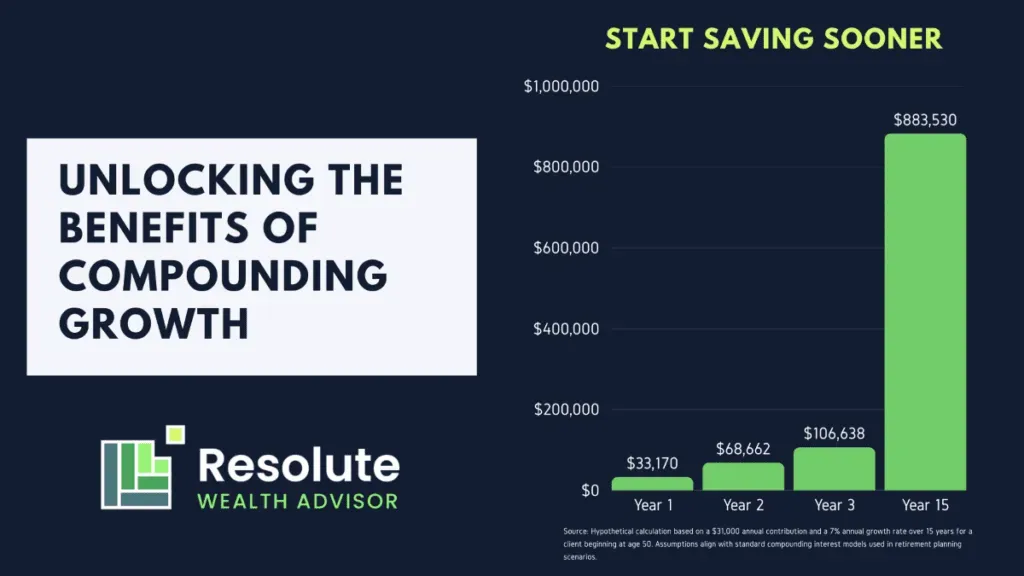
  • Exponential Returns Over Time: For someone starting at age 50 and contributing $31,000 annually, assuming a 7% annual return, the account can grow to approximately $883,530 by age 65[3]. This illustrates how even late-stage contributions can lead to significant growth.
  • Market Performance Adds Momentum: With a well-allocated portfolio, market gains compound year after year, potentially accelerating growth as your balance increases.
    By focusing on consistent contributions and allowing time to work in your favor, your 401(k) can become a powerful tool for achieving a secure and fulfilling retirement.

Avoid Common Pitfalls

While focusing on growth, be mindful of these common mistakes:

  • Delaying Contributions: Every year counts. Start maximizing your savings today.
  • Ignoring Roth 401(k) Options: Roth accounts offer tax-free growth and withdrawals, which can complement your overall strategy.
  • Failing to Review Your Plan: Regular check-ins ensure your investment strategy evolves with your goals and market conditions.
  • Neglecting to Stress Test Your Financial Plan: Failing to account for factors like inflation, market volatility, early death, or longer-than-expected lifespans can jeopardize the success of your plan. Regular stress testing ensures high probabilities of success even under adverse conditions.

Take Control of Your Financial Future

Turning 50 is an excellent time to reassess and refocus your retirement strategy. By optimizing your 401(k) contributions, adjusting your portfolio, and planning ahead for distributions, you can set yourself up for a secure and fulfilling retirement.

If you’re ready to take the next step, our team at Resolute Wealth Advisor is here to help. Contact us today to schedule a consultation and ensure you’re on the right track to meet your retirement goals.

[1] FEDERAL RESERVE BOARD. (2023). ECONOMIC WELL-BEING OF U.S. HOUSEHOLDS IN 2023. RETRIEVED FROM HTTPS://WWW.FEDERALRESERVE.GOV/PUBLICATIONS/2024-ECONOMIC-WELL-BEING-OF-US-HOUSEHOLDS-IN-2023.HTML

[2] USAFACTS. (2022). RETIREMENT SAVINGS DATA. RETRIEVED FROM HTTPS://USAFACTS.ORG/DATA-PROJECTS/RETIREMENT-SAVINGS

[3] SOURCE: HYPOTHETICAL CALCULATION BASED ON A $31,000 ANNUAL CONTRIBUTION AND A 7% ANNUAL GROWTH RATE OVER 15 YEARS FOR A CLIENT BEGINNING AT AGE 50. ASSUMPTIONS ALIGN WITH STANDARD COMPOUNDING INTEREST MODELS USED IN RETIREMENT PLANNING SCENARIOS.

Ryan Geary

The Wealth Advantage: Your Guide to Market Dynamics – Episode 1

Welcome to the first episode of The Wealth Advantage: Your Guide to Market Dynamics, our new quarterly video series designed to keep you informed about market trends and financial strategies.

In this video, Ryan Geary, Associate Wealth Advisor at Resolute Wealth Advisor, discusses:

  • The potential impact of tax cuts, deregulation, and policy changes.
  • How inflation and Treasury yields could shape the economy.
  • The outlook for U.S. equities and strategies for navigating challenges.

Watch the video now

Tax-Planning: Your Year-End Checklist

As the New Year approaches and the busy holiday season is upon us, your year-end tax planning may not be top of mind. You may well want to put off this work until January 1st or even April 15th, but doing this could lead you to overpaying – or facing anxiety about getting everything completed in time. We’ve put together this practical checklist of actions that you can take before the end of the year to minimize your tax liability. Consider these actions for a strong financial start to the new year.

Year-End Tax Planning Step #1: Income and Deductions

You may have received income from more than one source this year. It’s important to understand the potential deductions that each type may offer. Most year-end income and deduction forms are made available no later than January 31st.

  • Form W-2: This document outlines income earned from wages, salaries, bonuses, and tips.
  • Form 1099-DIV: This form reports dividends and investment distributions.
  • Form 1099-R: This form reports any distributions taken from various retirement accounts including annuities, profit-sharing plans, IRAs, insurance contracts, and pensions.
  • Form 1099-INT: This document is used by financial institutions and other entities to report interest income paid. If you received interest of at least $10 throughout the year, you should expect to receive a copy of this form.
  • Form 1099-MISC: This form outlines various forms of miscellaneous income, including rent, prizes, and awards. If you were paid at least $10 in royalties, or $600 in miscellaneous income throughout the year, you should expect to receive a copy of this form.
  • Form 1099-NEC: If you are an independent contractor, freelancer, sole proprietor, or self-employed individual, you will receive this form from any businesses that have paid you at least $600 during the year.
  • Form 1095-A: This is the Health Insurance Marketplace Statement and it is sent to individuals who have qualified coverage through a Health Insurance Marketplace carrier. Those who receive coverage from the Marketplace may be eligible for subsidized coverage or a tax credit.
  • Form 1098: This document outlines any mortgage interest or property taxes paid over the previous year. It will be sent to you by your lender, if applicable. Mortgage interest and property taxes are deductible expenses if you itemize.
  • Form 1098-T: This statement reports any qualified educational expenses paid throughout the year. This includes tuition, fees, and required course materials. If you paid qualified educational expenses for yourself or a dependent child, you may be eligible for certain education tax credits.
  • Form 1098-E: If you paid more than $600 in student loan interest throughout the year, you will receive this form. Student loan interest is an above-the-line tax deduction.

SEE ALSO: Why Tax Planning is an Important Part of Your Financial Plan

 Year-End Tax Planning Step #2: Investments

If you have investments, there are a number of ways this can impact your tax liability. Here are a few things you’ll want to keep in mind:

  • Tax Loss Harvesting: If you have unrealized losses in your taxable investment accounts, you may be able to offset the taxes owed on capital gains. If you have capital losses greater than your total capital gains, you can use the loss to reduce ordinary income by up to $3,000. With this strategy, investors can realize significant savings.
  • Net Investment Income Tax: You may be subject to an additional 8% tax on net investment income if your modified adjusted gross income exceeds $200,000 for single taxpayers or $250,000 for married taxpayers. If you know you will be subject to this tax, consider the possibility of deferring investment income to other years.
  • Rebalance Your Portfolio: Consider rebalancing your asset allocations if they are no longer in line with your investment objectives. This is particularly important if you have a concentrated equity position that may expose your portfolio to unnecessary risk. In other words, make certain you don’t have all your eggs in one basket.
  • Stock Options and AMT: Certain investments, like incentive stock options, can impact your alternative minimum tax liability. It’s important to review this before finding yourself caught off guard during tax season. A qualified financial professional can answer questions you may have on this topic.

Year-End Tax Planning Step #3: Retirement

While having a retirement plan is an important way to save for the future, it is also a helpful tool in minimizing your tax liability. As the New Year approaches, be sure to consider the following steps:

  • Maximize Retirement Contributions: If you have access to an employer-sponsored retirement plan such as a 401(k), 403(b), or 457 plan, maximizing your retirement contributions can save you on taxes. That’s because contributions are considered pre-tax and will directly reduce your taxable income at the end of the year. You can contribute up to $22,500 with additional catch-up contributions of $7,500 for those over the age of 50. Note that contributions must be made before December 31st.
  • Consider a Roth Conversion: Converting pre-tax funds to a Roth account can be a tax-efficient strategy if you are in a lower tax bracket. Since the funds will be taxable in the year of conversion, be strategic about your timing. Once funds are converted, they will grow tax-free with no required minimum distributions.
  • Take Your Required Minimum Distributions: Once you reach age 72, RMDs must be taken from all qualified retirement accounts except Roth IRAs. You have until April 1st of the year following the year in which you turn age 72 to take your first distribution. Every year thereafter, you must take your RMD by December 31st. Be sure to stay keep your eye on these, because if you fail to withdraw the full amount by the due date, the amount not withdrawn is subject to a 50% excise tax.

SEE ALSO: Charitable Giving Strategies for the End of the Calendar Year

Year-End Tax Planning Step #4: Charitable Giving

Giving back to causes and organizations you care about can have positive impacts in many ways. Many strategies can be used to reduce your tax bill while doing good at the same time. Consider the following:

  • Gifting Appreciated Assets: Donating highly appreciated assets that have been held for longer than one year has the potential to maximize your charitable contributions while minimizing your tax liability. You can typically avoid capital gains tax on these assets if you donate them to the charity directly, as opposed to selling and then donating the proceeds, so keep this in mind.
  • Bunching Donations: If you’re not familiar with this concept, you may want to consider ‘bunching’ multiple years of charitable donations into one tax year if your current deductions are below the standard threshold. This strategy allows you to consolidate your donations for two years into a single year to maximize your itemized deductions for the year you make your donations.
  • Taking a Qualified Charitable Distribution (QCD): If you are due to take an RMD that you won’t need to cover your expenses, consider a QCD instead. It allows you to donate to a 501(c)(3) organization that you care about while reducing your overall tax liability. You can make a distribution of up to $100,000 from an IRA to a qualified charity that counts towards your RMD – and it won’t be considered taxable income.
  • Consider Using a Donor Advised Fund: A donor-advised fund (DAF) is a giving account that is established at a public charitable foundation. It allows you to make a charitable contribution, receive a tax deduction, and then recommend grants from the fund to the charities of your choice over time. 

Are You Ready for Your Year-End Tax Planning?

Tax planning is complex, and the steps above may not cover all your needs or complement your overall financial planning goals. If you’d like professional guidance on your personal financial moves at year’s end, contact us today. At Resolute Wealth Advisor, our team can help guide you through the New Year and beyond, and we look forward to hearing from you!

The Philanthropic Family: How to Teach Your Children About Giving Back

At Resolute, we believe in helping clients understand the value they can provide by sharing their wealth to impact those closest to them and causes they are passionate about. (Our firm logo even reflects this conviction – check out The Giving Box story to learn more!) We also know that cultivating a sense of generosity and empathy in children is one of the most lasting legacies a family can leave. Teaching children about philanthropy not only fosters compassion but also helps them understand their roles in making a difference in the world. In this guide focused on how to teach your children about giving back, we explore strategies for fostering a spirit of philanthropy within the family, empowering the next generation to become mindful, compassionate contributors to society.


Why Teach Children About Philanthropy?

Instilling philanthropic values in children helps shape them into responsible, empathetic individuals. It encourages them to appreciate the importance of community, reinforces gratitude for what they have, and creates a foundation for lifelong giving. Studies have shown that children who engage in giving activities are more likely to develop prosocial behaviors, demonstrating empathy, kindness, and a sense of responsibility. Moreover, learning how to teach your children about giving back builds their self-confidence, showing them that they have the power to impact others’ lives.

Step 1: Lead by Example

Children often learn best by observing their parents’ behaviors. Showing them how to teach your children about giving back starts with incorporating philanthropy into your own routine. Whether through monetary donations, volunteering, or other acts of kindness, regularly participating in giving activities demonstrates your commitment to helping others.

Consider involving your children in some of these activities. Take them with you to a volunteer day at a local organization, or explain why you’re donating to a particular cause. If they see you engaged in meaningful acts of kindness, they’ll be more inclined to see giving back as a natural, fulfilling part of life.


SEE ALSO: Tax-Savvy Charitable Gifting Strategies

Step 2: Introduce the Concept of Gratitude

Gratitude is often the first step toward philanthropy. Helping children recognize and appreciate what they have is an essential foundation for understanding why giving back matters. Family discussions about gratitude can deepen this understanding, especially when framed in terms of helping those who may be less fortunate.

One effective exercise is to create a gratitude journal together, where each family member writes down something they’re thankful for each day. This habit can increase awareness of how others may benefit from generosity and naturally open up conversations on how to teach your children about giving back.

Step 3: Choose Causes Together

Involving children in the process of choosing causes to support can make philanthropy more personal and meaningful to them. Start by discussing various causes, explaining them in a way that resonates with their interests and experiences. For example, if they love animals, you could explore options like animal rescue organizations or local shelters. If they’re passionate about the environment, look into organizations dedicated to conservation and sustainability.

This collaborative approach teaches them that their voices and opinions matter, laying a strong foundation for lifelong involvement in philanthropy. Additionally, by involving them in decisions on giving, you’re showing how to teach your children about giving back in a way that aligns with their passions.

Step 4: Set Up a “Giving Fund”

Setting aside a specific amount for donations can make philanthropy a routine part of family life. A “Giving Fund” is a family pot that everyone contributes to over time, with each member having a say in where the funds go. This fund doesn’t have to be large—even small contributions can add up and create significant impact.

Encourage your children to add a portion of their allowance, birthday money, or other savings to the fund. This helps them understand the value of money and the impact their contributions can have, even at a young age. Setting up a Giving Fund is an effective, hands-on approach to how to teach your children about giving back.


SEE ALSO: Charitable Giving Strategies for the End of the Calendar Year

Step 5: Encourage Volunteer Activities

Volunteering as a family can be one of the most impactful ways to demonstrate the importance of giving back. Children can develop a deeper connection to a cause by experiencing it firsthand, whether through preparing meals at a food kitchen, helping clean up a local park, or visiting senior care facilities.

Look for opportunities that allow children to actively participate and see the immediate results of their efforts. For instance, they might help deliver donated items or sort supplies. The direct involvement helps them feel the impact of their actions, reinforcing the lesson on how to teach your children about giving back.

Step 6: Make Philanthropy a Family Tradition

Integrating philanthropy into family traditions makes giving back a lasting part of family culture. Consider dedicating certain holidays or events to giving, like donating food during Thanksgiving or volunteering around the holidays. Alternatively, you could create a new family tradition, such as an annual giving day where everyone shares ideas on which causes to support that year.

Making these activities a tradition builds excitement and continuity. Children come to anticipate these events, and as they grow, they’ll look back on these experiences as cherished family memories tied to meaningful contributions.

Step 7: Teach Financial Literacy Alongside Philanthropy

Understanding financial literacy goes hand in hand with learning how to teach your children about giving back. By helping them understand basic money concepts, like saving, spending, and donating, you can empower them to make informed, intentional decisions about giving as they grow.

Introduce the concept of “Save, Spend, Give” as part of their financial education. Have them divide any money they receive into three categories, allowing them to allocate a portion specifically for giving. This exercise not only strengthens their money management skills but also encourages a balanced approach to saving and spending with an eye toward helping others.

The Rewards of Family Philanthropy

Engaging in family philanthropy has benefits beyond teaching generosity. It fosters a sense of unity and shared purpose, strengthens family bonds, and provides meaningful opportunities to connect with the community. Children develop a positive self-image, learning that they can make a difference, while parents experience the joy of seeing their children grow into responsible, compassionate individuals.

Moreover, when families make giving a shared value, children are more likely to continue these practices as they become adults. They’ll remember the lessons learned and the moments shared, shaping a legacy of kindness and empathy that extends across generations.

Closing Thoughts on How to Teach Your Children About Giving Back

Learning how to teach your children about giving back is a rewarding journey that shapes them into thoughtful, socially conscious individuals. By starting with small steps—leading by example, fostering gratitude, and involving them in giving decisions—parents can nurture a lifelong love for philanthropy in their children. These early lessons in generosity, empathy, and social responsibility help create a future generation of compassionate leaders dedicated to making a difference.

In a world that often feels increasingly complex, the gift of giving back stands as a timeless and meaningful value. By teaching children how to engage in philanthropy meaningfully, parents are not only making an impact today but also sowing the seeds for a brighter tomorrow. If you’d like to discuss a meaningful charitable giving plan for your family, please reach out to us today.

Why Tax Planning is Essential for a Comprehensive Estate Plan

Navigating the complexities of estate planning often feels like a daunting task. This is not only due to the intricate laws and regulations that govern the field but also because of the emotional weight tied to contemplating your own mortality. Nevertheless, addressing estate planning is imperative if you want your assets to be allocated according to your wishes after your passing. For individuals with substantial wealth, the emphasis also includes devising a tax-efficient estate planning strategy to minimize the tax burden on heirs. Tax-efficient estate planning utilizes legal mechanisms and strategies to decrease the amount of taxes owed on an estate, and this article explores the importance of tax planning and several strategies that highlight this approach.


Tax-Efficient Estate Planning: Diminishing Estate Taxes through Gifting

One effective method to reduce estate tax liability involves gifting assets to beneficiaries during your lifetime. The IRS permits individuals to gift a certain amount annually to another person without incurring any gift tax. For instance, if you are married and have two married children and two grandchildren, you and your spouse can give up to $36,000 to each of your kids, their spouses, and the grandchildren in 2024 without having to file a gift tax return or pay any tax. This means you can give a total of $216,000 in tax-free gifts. Over time, these gifts can substantially lower the value of your estate and, consequently, the taxes owed upon it.

Charitable contributions present another avenue for tax benefits, alongside supporting causes you care about. Donating assets to charity can lead to an immediate tax deduction, lessening your present taxable estate. Seeking to create an impact beyond oneself has been an important priority for many of our clients at Resolute Wealth Advisor, and we would be happy to speak with you about strategies for contributing to the greater good while also keeping in mind the importance of tax planning.

Creating a Trust for Tax-Efficient Estate Management

Forming a trust constitutes another strategy for tax-efficient estate planning. Trusts are legal entities that manage and distribute assets according to the grantor’s instructions. Transferring assets into a trust can reduce the estate’s taxable value by effectively removing them from the grantor’s taxable estate.

Trusts vary, allowing for customization to specific needs. For instance, a revocable trust provides control over the assets during the grantor’s lifetime, while an irrevocable trust, which cannot be altered once established, offers substantial tax benefits like estate tax savings and protection from creditors.

Leveraging Life Insurance for Estate Tax Planning

Life insurance serves as a potent instrument in providing for beneficiaries while minimizing estate tax liabilities. Typically, life insurance proceeds are disbursed tax-free to beneficiaries, creating a reliable source of tax-free income.

Life insurance can also facilitate estate tax payments, preventing heirs from liquidating assets to cover these taxes. Purchasing a policy equivalent to anticipated estate taxes can preserve your estate’s integrity, easing the overall tax burden.

Enhancing Retirement Accounts for Tax Efficiency

If you’re exploring the importance of tax planning, don’t forget your retirement savings. Retirement accounts, such as 401(k)s and IRAs, can be pivotal in tax-efficient estate planning. By maximizing contributions to these accounts, you can lower your taxable estate’s value while securing funds for retirement. These accounts offer tax-deferred growth and potential tax deductions, furthering tax benefits.

Designating beneficiaries for these accounts means assets transfer directly to heirs, bypassing the probate process and associated costs.

Utilizing Family Limited Partnerships

Family limited partnerships (FLPs) may be particularly beneficial for high-net-worth individuals seeking tax-efficient estate planning. FLPs enable wealth transfer to family members while attracting valuation discounts for limited partnership interests, given the limited partners’ lack of control over assets. This results in a reduced taxable estate value.

FLPs also offer asset protection from creditors and flexible income and capital gains distribution among family members, supporting efficient tax planning.

Embracing Charitable Trusts in Estate Planning

Charitable trusts offer another strategy for reducing taxable estates. A charitable remainder trust (CRT) allows asset transfer to a trust, providing income to the grantor or beneficiaries for a set period before transferring the remaining assets to a charity. This strategy yields an immediate tax deduction for the charitable contribution and a reduction in taxable estate, alongside securing an income stream.

The Importance of Tax Planning in Estate Planning Success

Tax planning is a vital component of comprehensive estate planning, especially for those with significant assets. By integrating tax planning into your strategy, you can uncover opportunities to reduce tax liabilities, enhancing your financial well-being. This process requires regular review and adjustment in response to evolving financial situations and tax law changes, so revisit it as needed.

Embrace tax planning within your estate planning strategy to navigate the complexities of estate taxes effectively. The Resolute Wealth Advisor team of financial professionals is prepared to assist you in exploring tax laws and crafting personalized solutions to help you optimize your financial well-being and estate planning success. Would you like to know more? Contact us today to take the first step!

Schedule a Call