
Author: Scott Hohman, CFP®, AIF®

Dividend-Focused SMA Opportunities

A Low-Volatility Strategy Focused on Yield

This article marks the seventh and final installment in our Investment Strategy Series, where I’ve been introducing each of the valuable elements of our newly enhanced investing strategy for Resolute clients. If you’d like to review any of the previous articles, you may do so through these links:

Today, I’d like to discuss dividend strategy and, specifically, the opportunity to utilize a dividend-focused separately managed account (SMA).


Why Do You Need a Dividend Strategy?

If it’s your dream to retire someday with a steady, passive income, having the right dividend strategy can help you accomplish your goals. Of course, there are multiple ways investors approach dividend investing, and it can be daunting to select the investments in your portfolio that will give you the long-term income you desire. That’s why we’re excited to be offering Resolute clients access to a dividend-focused SMA that takes much of the guesswork out of building your own dividend strategy.

How Does it Work?
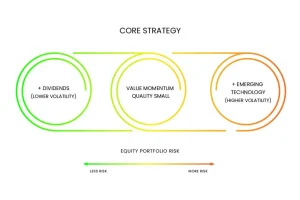
The dividend-focused SMA we have partnered with emphasizes holding large-cap stocks as a step to reduce downside risk. This strategy seeks out companies that are perceived to have free cash flow over the next three to five years to support the current dividend.

Traditionally, you might expect this strategy to underperform in strong upward markets, but also to provide more stability during volatile markets.

Is it Right for You?

Our offering is designed for investors who are seeking a lower volatility strategy in their stock allocation, with an emphasis on dividend yield. It is a strategy that is particularly well-suited for those who are looking to reduce the overall downside risk in their stock portfolio or those who are seeking income opportunities while still having the potential for capital appreciation. These investors understand that they are likely owning lower-risk stocks, but they do still own stocks and that carries more risk than fixed-income investments. So, utilizing this dividend strategy can be a fit for those who are comfortable with adding risk by reducing some of the fixed income portions of their portfolio and replacing it with income-producing stocks.

Do You Have Dividend Strategy Questions?

If you’d like to learn more about the services discussed in this article, or any facet of our enhanced investment management strategy, let’s talk. If you’re a Resolute client, reach out to your advisor at any time. And, if you’re not yet a client, schedule an introductory discussion so we can get acquainted.

At Resolute, we believe in helping you regain the personal aspect of your advisory relationship and in helping you better customize your investment portfolio. We look forward to getting to know you and your unique goals, and to answer your questions about dividend strategy or about our wealth management and investment management services. Our professional team offers the depth of experience, customized plans, client engagement, and a commitment to providing our clients with confidence in – and ownership of – their respective financial futures. If this sounds like what you may be looking for, reach out today. We look forward to hearing from you!

Tax-Savvy Charitable Gifting Strategies

Did you know that America is the most charitable nation in the world? In 2020 alone, U.S. charitable giving totaled $471 billion. What’s more, 69% of that giving was from individuals.

If you’re reading this article, it’s likely you’re a part of that tremendous show of generosity. When you decide to make a charitable gift, it’s a very personal decision. Most often, it’s about much more than money, too. It’s about your values, your passions, and your hopes for the future. Even though tax planning probably isn’t your main reason for giving back, though, there are several valuable benefits you should not overlook, some of which were strengthened by the Tax Cuts and Jobs Act (TCJA) of 2017.

Current Law

If you’re practicing philanthropy – that is, making donations of cash or property to charitable organizations – it’s important to take a few particular steps to ensure you qualify for current tax advantages associated with your giving.

You’ll need to:

  • Make sure your gifts are going to qualified charitable organizations.
  • Itemize deductions on your income tax return.
  • Meet gift documentation/substantiation requirements.

How much of your giving can qualify for a tax deduction? Well, prior to the TCJA, you could deduct up to 50% of your adjusted gross income as charitable gifts. Now, however, you can gift up to 60% of your income while still benefitting from the tax deduction.

Since the TCJA also doubled the standard deduction, many fewer taxpayers are itemizing. However, the CARES Act provided a $300 charitable tax deduction for both 2020 and 2021 tax years. For 2021, married couples who file jointly can deduct up to $600.

What if You want to Give Considerably More?

If you have the desire and the resources to give much more than $300 or $600 to your favorite charitable causes, there are two fairly straightforward strategies you may want to consider.

‘Bunching’ Contributions Through a Donor Advised Fund

Let’s say you typically give $10,000 per year to one or more qualified charitable organizations, but you stopped itemizing your deductions due to the increased standard deduction created by the TCJA. If you’re committed to continuing to give each year and you don’t want to lose out on the tax benefits associated with your philanthropy, you might consider “bunching.” This means putting several years’ worth of giving into a single year (maybe a single gift of $30,000 for the next three years) and placing this gift into a donor advised fund (DAF).

Here’s how it works, and why it’s tax-savvy, too. DAFs are separate charitable investment accounts. They’re easy to set up through a qualified custodian, and you can fund them with assets like cash, stocks, and bonds. Once your DAF account is open, you get to choose a strategy for how any of your gifted – but not yet granted – dollars will be invested, and then recommend grants of funds to any qualified charitable organizations you’d like to support. Contributions to a DAF are irrevocable, so you get an immediate tax deduction in the year you make the contribution, regardless of how long you take to distribute the funds. So, in keeping with the example above, you could make a contribution of $30,000 to your DAF now, enjoy the itemized tax deduction this year, but spread the grants out over three years so that you’re still contributing about $10,000 to your chosen charities annually (and taking the standard deduction in years two and three in this example).

Essentially, this strategy lets you front-load your giving in such a way as to enjoy multiple years of tax deductions in a single year.

Gifting Your Required Minimum Distributions

You’re required to start taking Required Minimum Distributions (RMDs) from your retirement accounts starting at age 72 – even if you don’t need the income for your living expenses. Typically, you pay income tax on these distributions. However, the IRS allows you to use your RMDs as tax-free gifts to 501(c)(3) charities instead. Essentially, if you don’t need all or a portion of your annual RMD for income, you can use it as a significant gift to a qualified non-profit – up to $100,000 per taxpayer per year.

This is called a Qualified Charitable Distribution (QCD), and it’s a valuable tool because it allows you to accomplish four things at once. You can satisfy your RMD requirement, avoid paying taxes on it, support a cause or organization you care about, and avoid the potential that your RMD might push you into a higher tax bracket or cause a phaseout of other tax deductions. It’s truly a win-win for you and the charities you support.


Are You Practicing Tax-Savvy Giving?

Philanthropy is a meaningful way to truly change lives, whether in your own community, on the other side of the world, or anywhere in between. Charitable giving helps to address critical needs, and your example of giving back can have the benefit of encouraging the next generation to focus on philanthropic giving, too. These are just a few of the reasons why the IRS allows you to reap some tax benefits from your giving, so be sure to optimize your giving, both for your own benefit and so that you’ll have more resources to give in the future, too.

At Resolute Wealth Advisor, giving back is foundational to our work in several ways. Not only are we as a team committed to making a positive impact in our community, but we encourage and empower our clients to make a difference, too. We have termed this dual commitment “The Giving Box.”

If seeking to create impact beyond yourself is a priority for you, contact us today to begin a conversation about how you can create a financial plan that serves both your family and the causes that matter to you. We look forward to helping you accomplish your financial and philanthropic goals!

Schedule a Call